
Field Guides / Mini Excavator
Pre-Purchase Field Guide
Buying a Used Mini Excavator
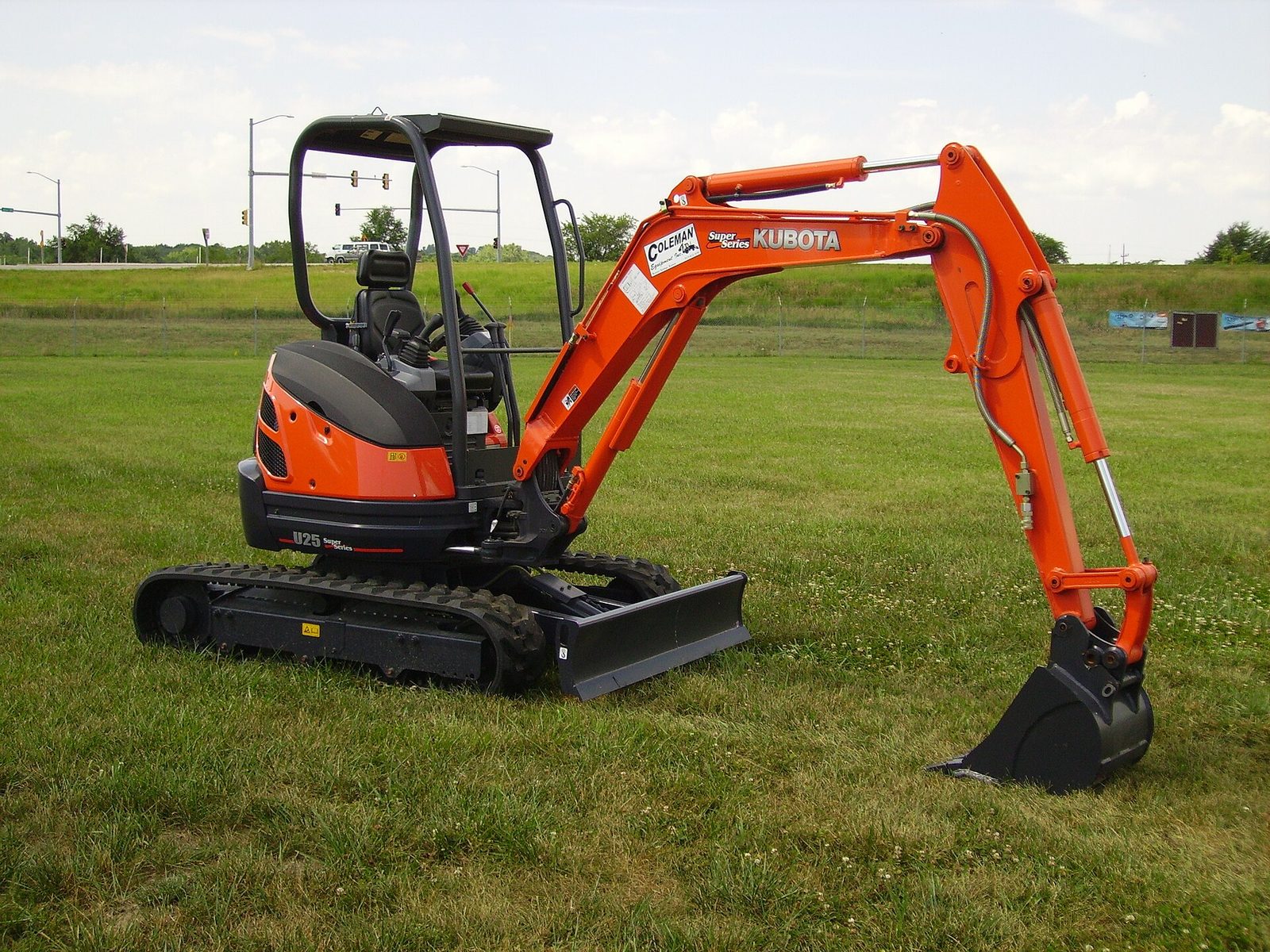
How to inspect a used compact excavator before you hand over the money. Tuned to the Kubota U-series (U17 / U25 class), but the method works on any machine of this size. Built to run one-handed on a phone, standing in the yard.
Do it in this order
Two of the most useful tests happen only once. The cold start is unrepeatable the moment the engine is warm, and the cylinder-drift test needs 15 minutes of the machine sitting untouched. Start both early. Everything else can happen while the drift timer runs.
Before You Go
The single most valuable instruction you can give happens before you leave the driveway: "Don't start it before I arrive." A cold start is your most informative five minutes, and it only happens once. Show up to a warm machine and you have lost it.
Questions worth asking first
- Can they pull the manufacturer's serial history report? A dealer usually can.
- Was this a rental, a trade-in, or a one-owner machine, and what work did it do? Rentals live hard lives.
- Aux hydraulics: flow rating in gpm? Bi-directional? Is there a case-drain line? This decides what attachments it can run.
- Does it come with more than one bucket, or a thumb?
- What warranty, if any? Push for 30 to 90 days on powertrain and hydraulics.
- If the seller has locations in more than one state, ask which store writes the deal. Sales tax can differ by thousands.
- Delivery cost to your site.
Bring with you
Flashlight, tape measure, calipers, a magnet, work gloves, a rag, your phone (photos and a timer), and a friend if you can get one. The magnet earns its place later.
The Cold Start
This is the test that tells you the most about the engine, and it cannot be repeated once the machine is warm. The engine should be stone cold to the touch when you arrive. Then watch the exhaust from the instant it cranks, and photograph or video it.
What good looks like
- Turns over crisply and fires within a few seconds.
- No starting fluid. If someone reaches for a can of ether, that is your answer.
- A puff of gray at startup is normal and clears in under 30 seconds.
- Idle is steady, not hunting or surging.
- No knocking, ticking, or persistent rattle.
Smoke color decoder
The color of the exhaust once it is running is the clearest single read on engine health.
| Color | What it means | Verdict |
|---|---|---|
| Gray puff, clears fast | Normal cold start | Fine |
| Blue, persistent | Burning oil: worn rings or valve guides | Walk away |
| White, persistent | Coolant in the cylinders, or bad injectors | Walk away |
| Black under load | Overfueling, dirty air filter, or a tired injection pump | Investigate |
Know what you're looking at: many machines in this class (the Kubota D-series diesel in the U17 and U25, for example) are indirect-injection, naturally aspirated, mechanically injected engines: no diesel particulate filter, no engine computer, no aftertreatment or regen cycle. There should be no warning lights and no electronic complaints on the dash. If there are, ask exactly what they are before you go further. Then let the engine warm to operating temperature before the hydraulic tests.
Undercarriage
This is the most expensive thing that can be wrong, and it is the thing sellers do not volunteer. Get on the ground with the flashlight.
Rubber tracks
- No cracking in the rubber, especially at the lug bases and between lugs.
- No chunks missing from the lugs.
- No exposed steel cord anywhere. Exposed cord means the track is done.
- Meaningful tread depth left, and even side to side. Uneven wear is a symptom.
- Correct tension: about 1 to 1.5 inches of sag at the midpoint of the top run.
Sprockets, rollers, and idlers
- Sprocket teeth still have flat tops, not sharpened to hooked points. Compare left and right.
- Every roller spins. Poke each one. A frozen roller is a dead bearing, and it grinds the track apart.
- No oil weeping from any roller or idler seal.
- The front idler tracks straight and is not gouged.
Ask directly: "What would you charge me to redo the undercarriage?" The answer tells you what they think it is worth, and if the tracks and sprockets are shot, that is real money and a real lever on the price.
Hydraulics
The cylinder-drift test (start it early)
The most important hydraulic test. Do it early so the machine can sit while you inspect everything else.
- Extend the boom out, curl the bucket, and raise it to hold a load.
- Shut the machine off. Set a phone timer for 15 minutes. Walk away.
- Come back. Any visible sag means failing cylinder seals.
- Repeat the logic for the arm and bucket cylinders.
Look and feel
- Cylinder rods: no pitting, scoring, or scratches. Run a fingernail down each one; a gouged rod eats seals forever.
- No weeping at any cylinder gland or hose fitting.
- Hoses not cracked, chafed, or bulging.
- Hydraulic oil is clean amber, not milky (water) or dark and burnt (overheated), and at the right level.
Function test: cycle every function under load, at full speed
Boom up and down, arm in and out, bucket curl and dump, boom swing left and right, house rotation a full 360° both ways, blade up and down, thumb open and close, the aux circuit both directions, and each travel track independently.
What you're listening and feeling for: a pump that whines or groans under load (tired pump); any function that is slow, jerky, or hesitant compared to the others; chatter at the end of a cylinder stroke; and anything that will not hold a load.
Tracking & Structure
Track it straight
- Push both travel levers evenly and drive 30-plus feet in a straight line. Does it crab or pull to one side? If so, a travel motor is weak or a final drive is failing, and that is expensive.
- Counter-rotate (one track forward, one back). It should be smooth and even.
- Drive up an incline if there is one. Any hesitation?
Hidden repairs and the boom
- Find any repainted panel, especially on the boom (a structural member and the ideal place to hide a crack repair). Look at it raking, at a low angle, with the flashlight; a repair throws a shadow.
- Feel for the ripple of body filler or the ridge of a weld bead under the paint. Bring the magnet; it finds filler.
- A painted-out rental or contractor name is standard practice and benign, but verify rather than assume. Photograph it and ask what was there.
- Boom foot and cylinder mounts: no cracks, no fresh weld. Blade straight, not bent.
Wear and identity
- Pin and bushing slop: rest the bucket on the ground, apply light pressure, and watch each joint. Visible movement means worn pins. Cheap to fix, but a bargaining chip.
- Cab or ROPS posts straight, with no sign of a rollover.
- Serial plate present, intact, and matching the paperwork.
Dig Test & The Rest
Do not skip this. Ask to put it in the ground.
Dig with it
- Dig a hole, load the bucket fully, and lift it. Does it have power through the whole curl?
- Does the boom lift a loaded bucket without straining?
- Grab something heavy with the thumb. Does it hold?
- Track over uneven ground and feel the undercarriage. Swing with a loaded bucket: smooth, or does it lurch?
Everything else
- Engine oil at the right level, not milky or sludgy. Coolant right, with no oil film on top.
- Air filter clean-ish and the housing sealed.
- Radiator and oil-cooler fins not packed with mud and chaff. A cooked machine starts here.
- Battery terminals clean with a hold-down present. Wiring free of rodent damage, hack splices, and electrical-tape repairs.
- Seat, controls, gauges, and lights all work.
- Wear-vs-hours sanity check: divide hours by the machine's age. Light use is roughly 150 to 200 hours a year. If it reads low hours but looks like it has done thousands, something is wrong.
Paperwork
- The manufacturer's serial history report in hand.
- Clear title, free of liens, and the bill of sale should say so. Ask it out loud: "Is this machine free of liens, and will the bill of sale state that?"
- Written warranty terms, if any.
- Do not rely on a vehicle-history button on the listing. Those services do not cover off-road equipment: the serial is VIN-shaped, so it will accept it and return nothing, which is not the same as a clean report.
On price
The things that legitimately move the number: undercarriage life remaining, any cylinder drift, pin and bushing slop, only one bucket, and no warranty. Season helps too. A dealer would rather not carry a machine into the off-season, so buying in the slow months is a quiet lever. Go in willing to walk. There will be another one.
Deal-breakers: walk away, no negotiation
Any one of these on its own is a reason to leave, regardless of the price.
- Persistent blue or white smoke that does not clear.
- Exposed steel cord in the tracks, or a frozen roller they won't fix.
- Visible cylinder drift after 15 minutes.
- The machine crabs when you track it straight.
- Fresh weld or filler on the boom, unexplained.
- Serial plate missing or defaced.
- They refuse a cold start, or refuse to let you dig.
- They won't warrant clear title.
You are not overspending by inspecting this hard. You're buying correctly.